Sustainability
Cutting Costs and Carbon with ECO2 at South Station
Sam Holtze
November 10, 2025
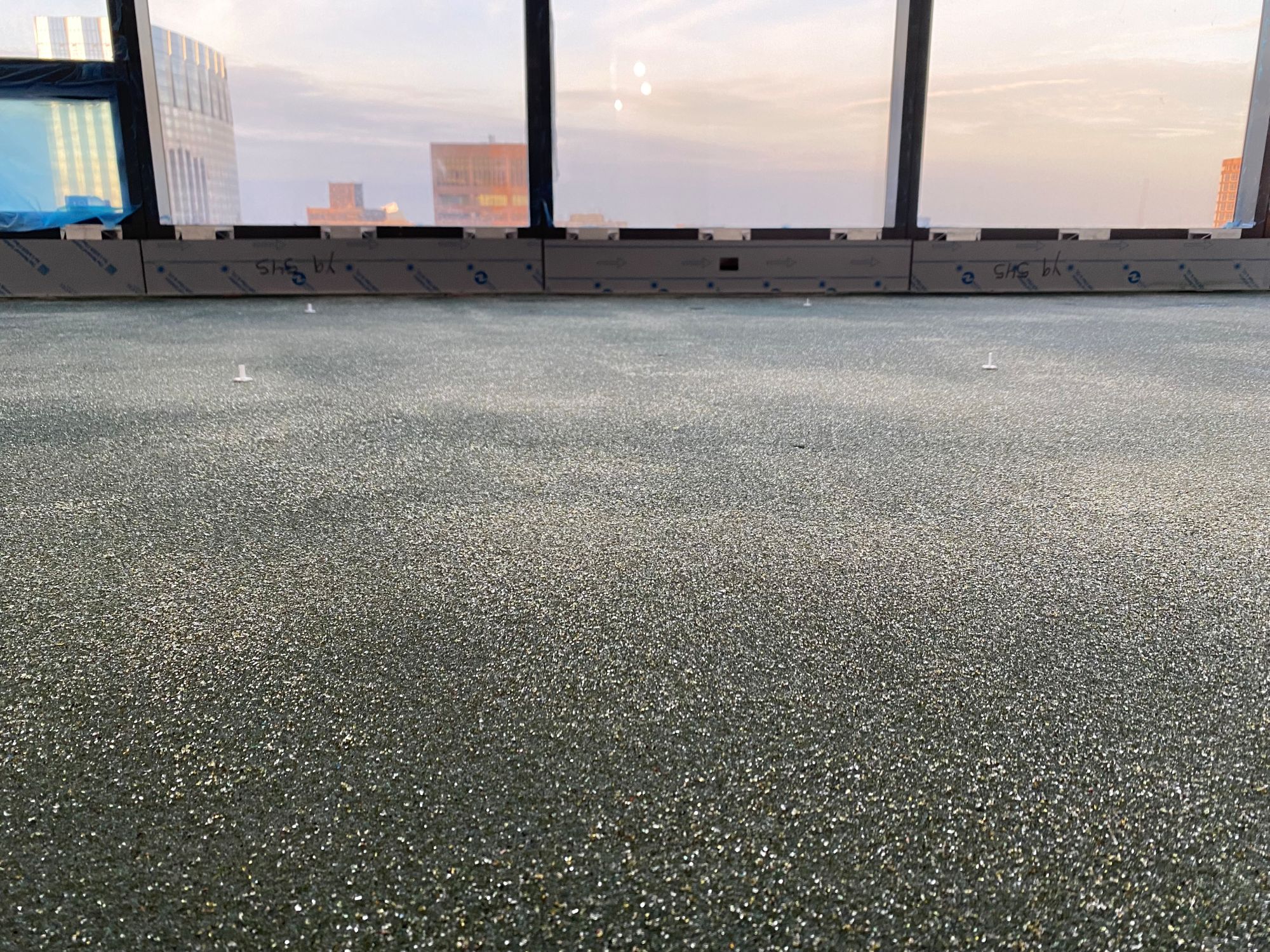
Finding a single material that improves worker health, lowers carbon, boosts circularity and reduces cost is rare. At our South Station Tower project, our team found a product that did exactly that. By switching to ECO2’s silica-free flooring system across 15 residential floors – with more than 250 tons installed with pavilion floors – we delivered measurable safety and sustainability gains while lowering total system cost and maintaining performance and schedule reliability.
ECO2 replaces mined silica sand with post-consumer recycled glass and uses renewable chemistry (cashew nutshell liquid, or CNSL) in its moisture mitigation layer. The result is a safer, lower-impact assembly that meets stringent substrate and moisture requirements for premium wood flooring, without a cost penalty. As a bonus, the system also costs about 25 percent less than comparable products.
Where silica exposure happens on jobsites (and how ECO2 helps)
Airborne crystalline silica becomes a serious hazard when dust is generated from common jobsite tasks, such as:
- Mixing or handling silica-bearing powders (e.g. standard leveling compounds and mortars)
- Cutting, grinding, or drilling concrete, masonry, terrazzo, or tile
- Dry sweeping or cleaning up fine dust
ECO2 eliminates silica sand from surface preparation and leveling products, helping reduce respirable silica exposure during mixing, placement, and cleanup. This capacity creates direct benefits for worker protection and Suffolk’s jobsite safety culture.
Why we chose the ECO2 product line
Typical cementitious surface prep and leveling products can include up to 50 percent silica sand, creating respirable silica hazards during handling and installation. ECO2 replaces that sand with recycled glass, enabling a silica-free surface preparation workflow that improves on-site health and safety while supporting circular economy outcomes.
How we applied the ECO2 system
To meet the flatness and moisture requirements for large-format wood flooring, the South Station team sequenced ECO2’s system as follows:
- ECO2 MMS™ RAPID to control subfloor moisture.
- While the first application was still wet, we broadcast ECO2 AGGREGATE™ to create a textured, high-grip surface and strong mechanical bond.
- ECO2 LEVEL™ underlayment and ECO2 FINAL FINISH™ delivered the final, smooth substrate.
This assembly reduced risk at the wood floor interface while streamlining installation for pavilion floors.
The Measurable Impact at South Station
- Circular materials, not mined sand. By substituting post-consumer glass for virgin sand, the project conserved about 690,000 pounds of mined sand and diverted roughly 1.4 million glass bottles from landfills — a tangible circular-economy outcome at high project scale.
- Cleaner chemistry, fewer emissions. ECO2 MMS™ RAPID is solvent-free with zero VOCs, avoiding an estimated 691,000 grams of VOC emissions versus conventional systems, according to the manufacturer.
- Renewable content in moisture control. Compared to traditional products, ECO2 MMS™ RAPID replaces 20 percent of petroleum with cashew nutshell liquid. That’s the equivalent of avoiding about 365 gallons of fossil fuel across 55,000 square feet of coverage on this project.
- Bottle-by-bottle diversion. Each 50-pound bag of ECO2 AGGREGATE™ diverts the equivalent of about 104 bottles, while ECO2 LEVEL™ diverts about 49 bottles — impacts that add up quickly at tower scale.
Health, safety, and workforce benefits
Removing silica sand from powders reduces exposure to a respirable crystalline silica during mixing and placement. The ECO2 system’s silica-free specification directly supports Suffolk’s jobsite safety culture while also simplifying controls around airborne particulates.
Performance fit for premium interiors
Large-format wood flooring demands stringent substrate flatness and moisture control. The combined suite of ECO2 products created a high-grip, moisture-managed, smooth surface tailored for wood installations. This approach helps in reducing callbacks and lifecycle risks associated with cupping, gapping or adhesive failures.
Conclusion
South Station demonstrates how a substrate system can do more than meet performance criteria; it can materially improve workforce safety, cut embodied impacts, and showcase circular, renewable solutions at commercial scale. With ECO2, Suffolk translated a flooring scope into a measurable sustainability and budgetary win, and a repeatable playbook for future projects.