What a 400-Year-Old Japanese Contractor Taught Us About the “Master Builder” Model
Parker Mundt
May 1, 2026
The legacy of the master builder
A “master builder” is a single individual or entity responsible for both designing and constructing a project, rather than the fragmented, multi-party model common in construction today. Our recent visit to Takenaka, an Osaka-based contractor founded in 1610, revealed what that model still has to teach U.S. construction companies — about training, innovation, and staying close to the work even as an industry changes around you.
At Suffolk, we take a lot of pride in the fact that we’ve been in business for more than 40 years. Compared to the contractors that we met during a recent Suffolk Global Partnerships visit to Japan, though, it’s a drop in the 400-year bucket.
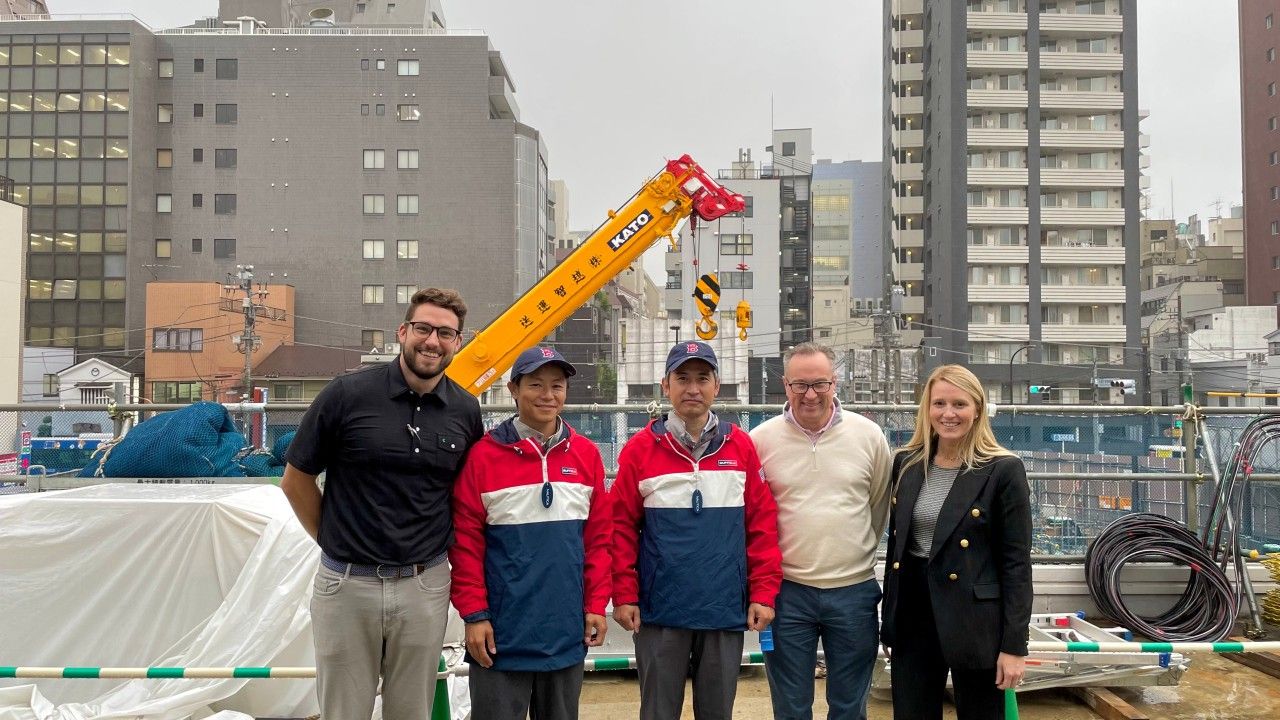
I’m talking about Takenaka. I wrote last fall that Suffolk has introduced an initiative to collaborate with cutting-edge international companies that are dedicated to resolving built world challenges like cost engineering, optimal building design, and supply chain management. Our visit with Takenaka represented our first Suffolk Global Partnerships trip. I wanted to take a deeper dive into our time in Japan, where we explored the DNA of master builders.
Back when Takenaka was founded, projects were delivered by a single master builder responsible for design and construction. You could even see it in the days of Filippo Brunelleschi, the founding father of Renaissance architecture, who designed and engineered the Duomo in Florence, then built it with the aid of machines that Brunelleschi himself invented just for the project. That’s a far cry from today’s highly fragmented construction industry, with dozens of parties involved in a typical project and upwards of 50 on larger infrastructure projects. Those roles range from consultants, engineers, and designers to vendors, suppliers, and subcontractors. For Takenaka and Brunelleschi, that was all wrapped into one entity.
What’s impressive about Takenaka is that even amid those changes, the company has both preserved its core and embraced innovation to embody the master builder ethos. Here’s what that looks like:
- A rigorous training program. Outside of Osaka, Takenaka has built an immersive training facility with hands-on mock-ups that let learners apply classroom lessons in a realistic, field-centric environment.
- A highly technical research and development institute. Takenaka’s 420,000-square-foot research facility is where the company develops new construction details, materials, and methods to meet project requirements. This approach is rooted in Japan’s history: during the high-growth decades of the 1950s to the 1970s, builders needed technical innovations to create a large volume of new structures in earthquake-prone regions. Takenaka developed those technical details in-house and offered them to clients on their projects.
Building in the United States is drastically different than building in Japan, but there are a few practices that we can shape to apply to the U.S. market. For example, we can invest in innovation spaces to develop the latest technologies and train our teams. In a world where our industry faces zero percent unemployment — meaning a severe labor shortage rather than a shortage of work — the need to get people up to speed safely is a top priority. We’re taking that seriously. In thinking about how to train the next generation of workers, we’re partnering with organizations like YouthBuild and Building Pathways and schools such as Franklin Cummings Tech and Madison Park High School to open doors to construction careers. We’re also exploring how we can continue to strengthen our relationships with subcontractors, including through Build With Us @ Suffolk, our trade partner accelerator program; subcontractor safety trainings with our safety teams; and walk-on applications at jobsites so we can hear what other trainings people in our communities would be interested in.
Takenaka’s technology and innovation approach also reflects our explorations of how robotics, AI, and other solutions can create safer, more efficient jobsites. We’re taking that step with 100MAG, Suffolk’s new center for innovation on our Boston campus. This hub will support teams in the field, integrate design and supply chain for seamless delivery, invest in advanced technologies, elevate design for integrated project delivery, stitch together the latest in AI solutions, and scale tools that have proven to provide the most value.
Given its legacy in Japan, Takenaka has a deep-rooted history in working the way it does. Even as they innovate, they’re preserving their identity as a builder. That’s the advantage of staying true to the master builder mindset and close to the work — it’s served them for more than 400 years.